
There’s a moment at every well-catered event, usually about twenty minutes in, when the room relaxes. Conversations get louder. People stop checking their phones. Someone laughs a little too hard at something, and suddenly the whole space feels alive. That moment rarely happens by accident. More often than not, it starts with the food.
Finger food has a particular magic to it. Unlike a sit-down meal, where guests are anchored to a chair and a fixed plate, canapés and bite-sized pieces invite people to move, mingle, and try things. The food becomes part of the experience rather than a pause in it. And when the menu is thoughtfully designed around your specific event, the results can be genuinely memorable.
But how does a custom event menu actually come together? What goes into the decisions behind what ends up on that tray? Here’s an honest look at the process, from the very first conversation to the moment your guests take their first bite.
It Starts With a Conversation, Not a Menu
The biggest mistake in event catering is reaching for a standard menu before understanding the event itself. Every booking begins with a proper briefing, not just a headcount and a date, but a real conversation about what you’re trying to achieve.
Who are your guests? Are they colleagues at a corporate milestone, friends at an engagement party, or clients at a product launch? What’s the tone, formal and elegant, or relaxed and fun? Is it an afternoon event or an evening one? Will there be a bar? Are children attending?
These questions matter because the food has to fit the occasion. A platter of delicate smoked salmon blinis works beautifully at a law firm anniversary dinner. The same tray would feel out of place, and go largely untouched, at an outdoor summer birthday where guests are wearing shorts and sandals.
This is also the stage where we gather dietary information. According to research compiled by ZipDo, food allergies are a concern for 40% of catering clients, and the top three dietary preferences requested in catering are gluten-free, vegan, and keto. That’s not a niche audience; that’s nearly half your guest list potentially needing options they can actually eat. Getting this right early means no one spends the evening standing awkwardly next to a tray of food they can’t touch.
Thinking About Flow and Format
Once we understand the event, we start thinking about how food will move through it. This is less about individual dishes and more about the overall rhythm of the evening.
A two-hour cocktail reception has different needs than a four-hour celebration. Industry guidelines suggest planning for 10 to 12 pieces per person per hour when finger food is the main offering, but that’s just the starting point. If drinks are flowing freely, people tend to eat more. If there’s a formal speech or presentation mid-event, appetite dips during it and surges afterwards.
We also think about temperature and variety. A well-designed menu moves between hot and cold, light and rich, familiar and unexpected. You might open with something fresh and easy, a zucchini and ricotta tartlet, perhaps, or a cucumber round with dill cream, before moving into heartier offerings as the evening progresses. Ending with something slightly sweet (a mini salted caramel brownie, a passionfruit tart) gives guests a sense of completion without needing a formal dessert course.
This kind of careful sequencing is what separates a thoughtfully designed menu from a list of items that simply exist in the same room.
Building the Menu Itself
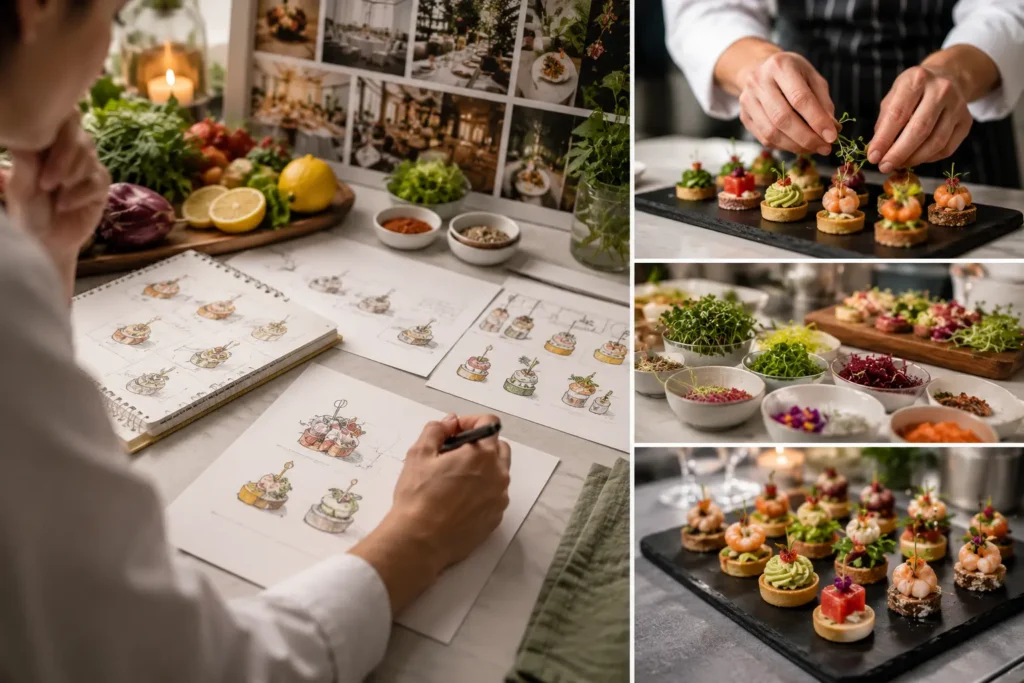
With the brief and the format clear, the actual menu-building begins. This is where the creative work happens, and it’s more considered than most people realise.
Each dish needs to pass a few practical tests before it earns its place:
Can it be eaten in one or two bites, standing up, without cutlery? This sounds basic, but it eliminates a surprising number of options. Anything that drips, crumbles dramatically, or requires two hands to manage is a liability at a cocktail event.
Does it hold well? Finger food often needs to be prepared in advance and held at a temperature. A canapé that looks perfect straight out of the kitchen but collapses fifteen minutes later is a problem, regardless of how good it tastes.
Does it complement the rest of the menu? If three dishes all feature pastry, the menu starts to feel heavy. If everything is cold, it can feel underwhelming on a winter evening. Balance is the aim.
The research backs up how much presentation matters here. According to ZipDo, 67% of caterers list food presentation as a key factor in client satisfaction, and that tracks with what we see on the ground. People eat with their eyes first, especially at events where the food is being passed around on trays rather than discovered on a buffet table.
Seasonal and Local Considerations
A good menu is also a timely one. Ingredients in season taste better, cost less, and, increasingly, matter to clients who care about where their food comes from. Research shows that 65% of event planners now prioritise local sourcing for their catering decisions.
Seasonal thinking also helps with creativity. Spring menus might lean on pea shoots, asparagus, and fresh herbs. Autumn is the time for roasted root vegetables, duck, and warm spiced flavours. Working with what’s actually good right now, rather than defaulting to year-round staples, makes for a more interesting and honest menu.
Tasting and Refinement
Before anything is confirmed, there’s a tasting. This isn’t just a formality; it’s where the menu is truly finalised.
A tasting lets you experience the food the way your guests will: in sequence, in person, at a realistic portion size. It also creates an opportunity to fine-tune. Maybe one dish needs a touch more acidity. Maybe a canapé that looked elegant on paper is actually awkward to eat. Maybe you try a smoked duck option and immediately know it’s the standout of the evening.
Feedback from tastings regularly changes menus for the better. The goal is to arrive at something you’re genuinely excited about, not just something you’ve approved.
On the Day
Every element of the menu comes with a service plan: what gets passed when, how frequently, how the dietary options are identified and communicated to guests, and how the team manages temperature and timing throughout the event.
The food is only half of it. The way it’s served, the attentiveness of the staff, the pacing of the trays, and the way a guest with a dietary need is quietly pointed toward the right option are what tie everything together.
The end result, when it works, is an event where the food is genuinely talked about. Where guests ask who catered it. Where the host feels proud rather than relieved.
That’s the goal every time. And it starts with a conversation.
Planning an upcoming event? Get in touch to discuss what a custom menu could look like for you.
Delivery Sydney-Wide
We deliver delicious and affordable gourmet finger foods to areas right across Sydney, including: