
Planning a party, engagement, or work function used to mean picking one menu and hoping it suited everyone. These days, that approach rarely works. Chances are, at least a few of your guests will be vegetarian, vegan, or simply eating less meat than they used to, and if you don’t plan for it, you’ll end up with awkward gaps on the table and guests picking at a plain side salad while everyone else tucks into the good stuff.
The good news is that catering for a mixed crowd doesn’t have to be complicated. With the right approach, particularly finger food that’s designed to be shared, you can put on a spread where every guest, regardless of what they eat, has plenty to choose from.
Why This Matters More Than It Used To
This isn’t just a fringe consideration anymore. The Australian Bureau of Statistics found that one in twenty Australians aged 15 and over now identify as vegetarian or vegan, and the number is higher among younger and middle-aged adults, with people aged 30 to 49 the most likely group to follow a vegetarian or vegan diet (ABS, Dieting and Food Avoidance, 2023).
But that figure only tells part of the story. A national survey by CHOICE found that a large share of Australians who aren’t full vegetarians are still actively cutting back on meat, and separate research from the University of Adelaide found close to one in five Australians (19.8%) are consciously reducing how much meat they eat (CHOICE, 2025). Add food allergies and intolerances into the mix, and the ABS separately reports that around 7% of Australians avoid certain foods due to allergies (ABS, Dieting and Food Avoidance, 2023).
Put simply: if you’re hosting more than a handful of people, it’s likely that a meaningful chunk of your guest list has some kind of dietary preference or restriction. Planning around that from the start saves you from awkward last-minute substitutions on the day.
Why Finger Food Solves This Problem So Well
A sit-down meal forces you to commit to a set number of meat dishes and a set number of vegetarian ones, and there’s rarely much crossover between the two. Finger food works differently. Because guests can pick and choose from a spread, you can offer a genuinely even split of options without anyone feeling like they’re stuck with the “leftover” choice.
It also solves a problem that a lot of hosts don’t think about until it’s too late: cross-contamination and awkward labelling. A shared grazing table or a formally plated three-course meal makes it hard to keep vegetarian dishes separate and clearly marked. Individual, bite-sized items are much easier to serve on separate platters, label clearly, and keep apart from meat-based dishes, so vegetarian guests aren’t left guessing what’s safe to eat.
Building a Menu That Works for Everyone
The easiest way to think about this is not “meat dishes plus a vegetarian option,” but building the menu so meat and vegetarian dishes are equally good from the start.
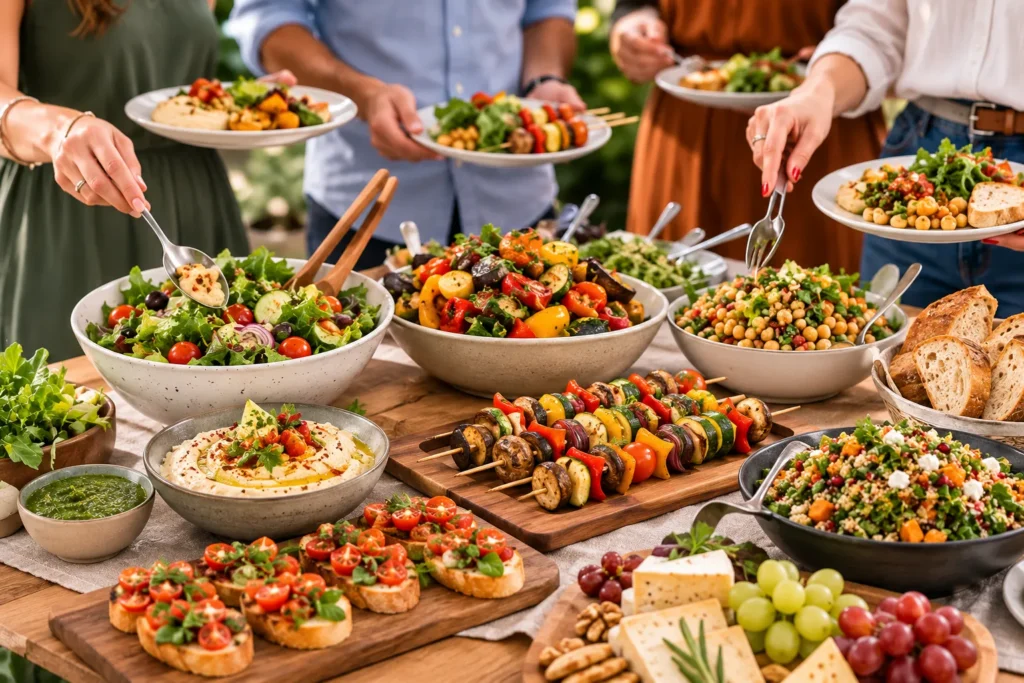
Start with dishes that don’t need much adapting. Think arancini, stuffed mushrooms, mini vegetable tarts, and spring rolls. These aren’t “the vegetarian option” tacked onto the end of the menu; they’re dishes that hold their own alongside anything else on the table.
Double up on shared favourites. Some finger food, like bruschetta, dips with flatbread, or vegetable skewers, works for everyone regardless of diet. These are useful because they don’t need to be split into “this one” and “that one” categories, which simplifies both your planning and your catering brief.
Match your ratio to your guest list. If you know half your guests are vegetarian, don’t just add one or two token vegetarian trays. Aim for something closer to an even split across the whole menu, so vegetarian guests have as much variety and choice as everyone else.
Ask your caterer about vegan and gluten-free crossover items. Many dishes that are vegetarian can be made vegan or gluten-free with small adjustments, which means one dish can often cover multiple dietary needs at once, rather than needing a separate tray for every category.
A Few Practical Tips for Hosts
- Ask early, not on the day. When you send invitations, include a simple line asking guests to flag any dietary requirements. This gives your caterer time to plan properly rather than scrambling for a substitution.
- Label everything clearly. Small cards or tags on platters showing what’s vegetarian, vegan, or gluten-free save your guests from having to ask, and save you from repeating yourself all night.
- Don’t assume vegetarian means bland. A good caterer will bring the same care and flavour to a mushroom arancini as they would to a beef slider. If the vegetarian tray feels like an afterthought, guests will notice.
- Talk to your caterer about quantities. If half your guest list is vegetarian, say so clearly when you book. A caterer who knows this in advance can plan proportions properly, rather than guessing and running short.
The Bottom Line
Feeding a crowd with mixed dietary needs isn’t about compromise anymore; it’s about good planning. With Australians increasingly moving toward vegetarian, vegan, or reduced-meat diets, a menu that treats these options as an equal part of the spread rather than an afterthought will leave every guest well fed and happy. Finger food makes this easier than almost any other catering style, because it lets you build a genuinely balanced, flexible menu without doubling your workload.
If you’re planning an event and want a menu that works for your whole guest list, talk to your caterer early about numbers and preferences. A few simple questions upfront make all the difference between a spread where half your guests are picking at scraps, and one where everyone leaves full and happy.
Delivery Sydney-Wide
We deliver delicious and affordable gourmet finger foods to areas right across Sydney, including: